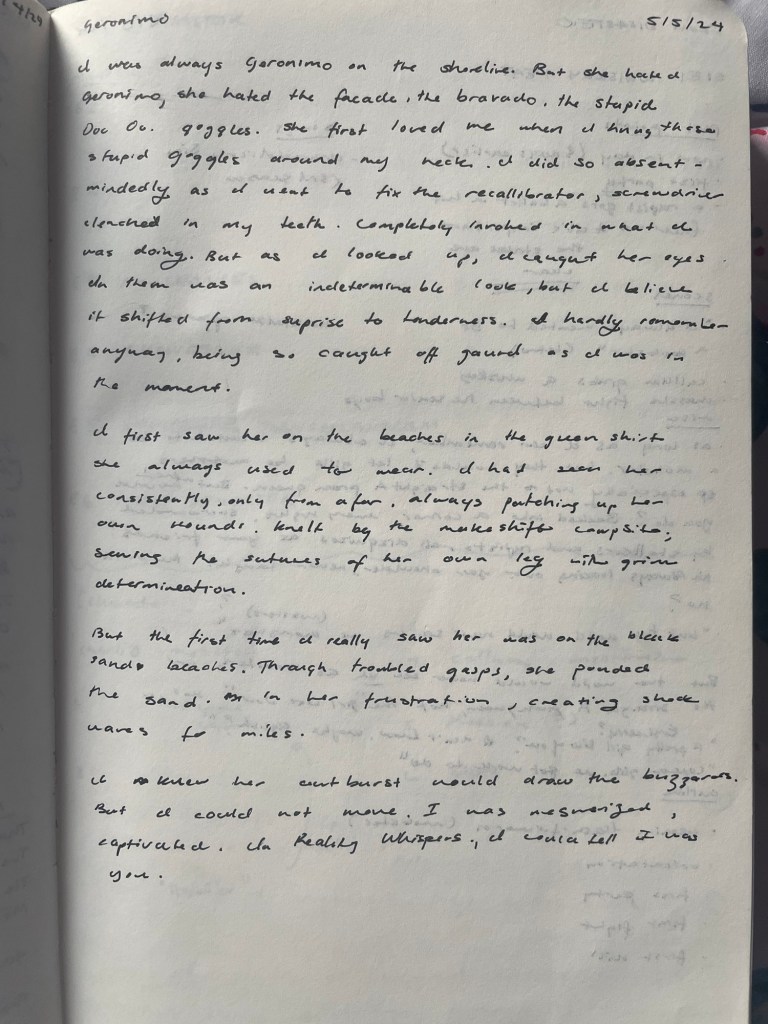
geronimo
Rosmond was a quiet out-of-towner when Ezrah met her first four years ago. She smiled well on command, but she wouldn’t invite herself to talk to you and she would stop eating if she knew you were watching.
Ezrah thought she didn’t eat at all when his parents told him to come to lunch with the nice new family in town with a daughter your age, Ezrah. He watched her hand hovering over her fork to see if he could catch the butterfly wing movement of her picking it up, but she did not. She kept her head bent. Halfway through Ezrah’s grilled cheese, she could finally talk to him.
“Can you stop watching?” she said in a voice that only reached as far as Evander in the seat next to Ezrah. There was not a daughter four years older like Evander but Evander had to come to this stupid lunch anyway.
“Why don’t you just eat?” Evander snapped. Rosmond could not answer. She also could not eat. She still could not answer until Ezrah’s parents took them to see the lovely little boardwalk just outside of town. Evander stepped over the still water tide pools and stilled the waving anemone with the point of a stick.
“Why not just leave it alone,” she whispered, and only Ezrah heard her.
“Come look at this, Hazel. It’s a sea monster,” Raymundo taunts. Hazel sticks out her chin.
“I know that’s not a sea monster. That’s a mamenomy,” she stumbles over the word. It waves its fingers at her, and in return she pokes its stomach to make it flinch away from her.
“Gotcha!” she grins. Ray grumbles and looks for something else to torment his sister with.
“Your cousins are pretty cute,“ Ezrah comments. Rosmond nods slowly and silently, but she does not speak. Ezrah surveys the boardwalk for an interesting conversation topic, but the small town of Brightview is a sleepy little thing, and he quickly grows restless.
“Why don’t we go play with them?” he asks, knowing Rosmond will not ignore a direct question.
“I shouldn’t get involved,” she says. Hazel and Ray move down the beach and Rosmond gets up to follow. Ezrah notices that she does not mention him in her response. She does not say that Ezrah should not leave her to play with her cousins, but he knows better than to leave her alone on the beach.
PART 1 – THREE OF SWORDS
Adrian leaned casually on the funeral parlor’s overly decorative side table. Their backwards baseball cap sat at a slight angle and they were dressed perfectly casually, more appropriate for a baseball game than to make arrangements for their dead uncle’s funeral. But Adrian was alone. There was no one, no one there to tell them that they should dress nicer or show more respect, so Adrian was going to dress however they damn well pleased.
The undertaker motioned to Adrian with a stoic gesture of her head. Adrian sighed and followed her. Despite their casual attitude, they were dreading this moment. This unfortunate moment of finality.
Uncle Bahir had his own room. Which Adrian was sure he disliked greatly. He always craved attention and activity, and he was quick to laugh, a laugh that originated deep from his stomach.
Adrian quickly repositioned their baseball cap as a way to avoid their growing sentimentality. The undertaker lead them to the casket. Bahir was half uncovered by the two-part lid, as if tucked in for bed or something inane like that. He was done up, so to speak. The undertaker had worked her magic and Bahir looked better in death than he ever did in life. Though vivacious, he was prone to dark circles. Though he loved life, he also worked himself to the bone.
Adrian wondered if Bahir should have been shrouded in white, but they wouldn’t know what to say. They had been on a long-haul red-eye flight when funeral arrangements were put in to action. The shroud, even, was only something Adrian noticed in passing at the funeral of Uncle Bahir’s great aunt or third cousin or something like. Adrian only enjoyed in passing a connection with the muslim faith theoretically belonged to them.
The undertaker looked expectantly at Adrian. Adrian looked back at her.
“Yeah, he’s dead alright,” they said. The undertaker, a very professional undertaker, simply nodded and lead Adrian to her office to discuss the funeral details.
Was there ever, she reflected, a proper response to being shown the body of a loved one?
Xavier watched the new girl carefully. She was hiding something. That’s all he knew, but everybody who walked nervously though his door was hiding something, and his employer had made it clear that she had a secret, a secret that mysterious man wanted his hands on.
Xavier questioned this man’s motives, but who was he to refuse cold, hard cash? Not credits, real money. Real money that could buy real food and real clothes. Money that even a human couldn’t refuse. And all for one secret off this girl, this small, nervous girl who looked no older than sixteen.
The man had assured him that she was a 30, nothing he couldn’t handle, but she was hiding something, something that meant real money to a hooded figure with a raspy voice. Xavier smiled at the girl and stuck out his hand.
“Welcome, I’m Xavier.” The girl bit her lip and shook the offered hand.
“Elia.” He glanced at her report. Eris Athena, it said. This was the one. Her file was small and insignificant as she looked. An uneventful Sigma training and the early dismissal that so many unremarkable wizards received. He couldn’t say he was jealous.
Elia knew he wouldn’t be, but she didn’t care what he thought. Right now, she was
occupied with another thought: How would she hide who she really was? It was easy around humans. For all they knew, if you scored a 30 on the WAP, you were a 30, and that was that, but this kid was a wizard, a seer at that. Only Pi’s became seers. He would be powerful and would have no problem dealing with her tricks.
Volume I: A Study in Dæmons
Prologue: Not a Story for Children
The bartender noticed the girl as soon as she walked in. She was sitting as far away from other people as she could get with a dense history book spread out in front of her. The bartender knew he could get to her whenever he wanted and she would act as though it had taken only minutes, but he didn’t want to keep her waiting; a bartender could be quite
loyal to his regulars. He walked up to her in seconds.
“What’ll it be?” She looked out the small window at the slick streets.
“Awfully cold out today.”
“A mulled wine it is then.”
“Thanks, Alfie.”
When Alfie came back with her drink, the girl had again lost herself in the book. She reached absentmindedly towards the cup. Alfie leaned over the bar, slightly, in interest. Still unable to read a word, he drummed his fingers on the bar.
“What is it today?” She was studying Chemistry and Medieval and Renaissance History at university, and Alfie was always interested in learning more on any subject from a developing expert, someone so excited about something he found dry, and this girl always had a story to tell.
“I’m afraid it’s not a story to put one in a good mood,” she confessed. “It’s not a story for children; however, it is unfortunately about children.” She looked around at the other customers before she continued. It was one of the usual set of signals. Do you have time?
He nodded and leaned in. Go ahead.
“Have you heard of a man call Gilles de Raise?”
“I can’t say that I have.”
“You know his legacy I’m sure. He’s the very real basis for the legend of Bluebeard.”
Despite her warnings of a bad mood, Alfie was intrigued. The girl saw this and continued.
“The beginning of his life hardly gives hint to its end. He fought alongside Joan of Arc in the Hundred Years War and married into money, well, after squandering much of his
father’s, but the technicalities don’t change much. The man was desperate for money. He advertised for an alchemist, or anyone who dabbled in the occult. You would have to be a
fool to agree, but I suppose Prelati didn’t know that when he signed on. He knew what he was doing but not how far it would go.
“Gilles de Rais wanted to raise a demon. He drew up a contract while Prelati
attempted contact. The demon was to give de Rais wealth, in turn for what we’ll never know. In any case, the story ends the same. Prelati’s first three attempts were to no avail,
and de Raise grew impatient. In what was, perhaps, a desperate attempt to defend himself, the failing demon summoner told his master that this demon, the demon Barron it was
called, required an offering, an offering of the sort one should never provide. This offering…well, it represents a crime viler than almost any other, a crime against society. It should be selected against, evolutionarily; it just doesn’t make sense–”
“What was it?” Alfie interrupted. The girl pressed her lips together and looked up at him.
“This is the part that might put you in a bad mood.” Alfie shrugged.
“Haven’t got much else to do.” The girl looked away, staring to the left of his hands.
“He asked for…parts…of a child.” Alfie was undeterred.
“What parts?”
“Well, based on his method of killing,” she looked down a the book, tracing a few highlighted words, “could be head, limbs, organs, but…most likely genitals.”
Alfie nodded stiffly.
“Lovely.” The girl laughed and her gaze turned softer, more contemplative.
“Well, he brought the parts, whatever they were. And while most agree he
summoned no demon, I am sure he did, for a demon would live inside him and would destroy lives and families. It would give him no wealth, but maybe he received another reward, a reward to him but in the eyes of all others, a curse. Maybe pleasure from others’ pain is a reward for the beholder. Maybe for him–” Alfie interrupted another one of her tirades.
“What did he do?” She looked straight at him with an intensity that made him shiver
in the warm pub.
“He was a child-killer.”
Since he had already expressed his interest, Alfie was unable to escape a detailed account of the real Bluebeard’s preferred killing method and rituals. He was only able to escape after hearing the disposal method of cutting off and burning small pieces of the corpse one at a time when another customer hailed him from further down the bar. Alfie eagerly took the chance to bid her adieu, and Rosemary Clearwater returned quietly to her uplifting bit of
literature.
Chapter 1: An Objective Account of the Occult
I guarantee you will not believe a single word of what I am about to write. So unbelievable is it, even to myself, that I have enlisted the help of a few of my good friends, experts in these sorts of dealings, to write much of what will follow. However, I thought I myself
should take the time to enclose a brief note to assure you the accounts that follow are completely objective and entirely factual, and if you cannot believe that, I invite you to hear
what Rosemary Clearwater has to say on the matter.
Allow me a brief introduction. I am Rosemary Clearwater. I attend University College London, and, by special arrangement, my field of study is so completely nebulous that naming it as any subject in the realm of history or the natural science would not be entirely
the truth but would also involve no deception whatsoever. Anymore of my biography would be superfluous.
In an attempt to offer you the most detailed and accurate account possible, I shall take it upon myself to describe preliminary knowledge of this particular case:
The Occult is an umbrella term for practices and beliefs that often stem from mythology. It describes not just supernatural or mystical phenomenon but the attempt to create and control such events. It represents the simple leap from trying to explain the unexplainable to an expectable and natural grab for power. The Occult is no occupation, though it fully occupies all involved. Possession, by spirits, devil,
dæmons, etc., only occurs when one attempts to posses something that is not one’s own. Dæmons specifically are a wildly fascinating division of the Occult. They appear so frequently on the underbelly of popular literature and cinema and fears so readily in these media, yet they are quickly and glibly dismissed in broad daylight. The fascination with and belief in dæmons is not limited to horror films or fringe groups and hidden cults. Carl Jung himself identified the shadow, or the ‘evil’ contained in the Self, as its own dæmon to be faced and dealt with, suggesting that humankind as a whole is incurably possessed. In fact, the more contemporary psychoanalyst James Hillman…
Etc. etc. etc.
She carefully shines the bottom of a tall thin Collins glass. She has the time. The bar is dead. The creak of the door breaks the silence. She looks up. Unhurried.
“Has Mr. Williams been by yet?” he asks, sitting down. She picks up another glass.
“Didn’t he die two weeks ago?”
“Two weeks,” he agrees. “I buried him a week ago and he still hasn’t found his way here?”
“Nope, no sign. But this fellow here,” she gestures to an empty stool, “just washed in. He fought in the Vietnam war.
“How’d he end up here?” he asks
She gestures to the rolling waves from the west-facing window.
Spirts dwell not only in the places they die, but more often in the places they lived, the places they loved. Some spirits, however, get lost trying to find their way from the first place to the second. Like the sailors lost at sea, or the fishermen who have fallen in, or even a spirit stranded many miles from home across a strange insurmountable ocean. These spirits spend weeks, years, centuries tumbled in the unfeeling waves, but eventually, they all wash up here, shake themselves off, and step in for a pint.
At our carefully planned rest stop, Emma and Eleanor, nearly inseparable themselves, giggled to themselves as they picked out and Emma bought what would seem even to the most sugar hungry to be too much candy. Eleanor’s parents were not rich, and that in an expensive private school as ours made her feel always slightly out of place. Her finances felt to her like a dark secret that she confided in Evony and Davynn late one night on a school trip to DC. She lived in a small house on Westminster Avenue, she had two sisters, and though she was as quiet as a mouse, she played the piano like a queen. Her quietness too she carried like a burden, and none but her closest friends would often hear her talk.
The rest of us easily paired off as well. The strange group we had gathered was made up of these pairs with tenuous connections between them. It seemed odd that this had happened. Senior trips took longer than two months to plan and were talked about since the beginning of the year, not since there were four extra spaces in a grey rental van. But Emma had wanted to take a trip, and she had wanted to take a big trip. She gathered and convinced her friends, but all others she recklessly asked had other plans. But Emma wanted a bigger trip, with more people and more to do, so Evony arranged to rent an eight-person van and asked me quietly to bring three of my own. Those I could convince stopped at two, so Ansel would extend the offer to his closest friend, Joseph, and that, it seemed, was the strangest part of the trip. No one had expected Joseph to agree. They expected him to have parties to go to and girls to hook up with. They expected him mostly to have better things to do than to be seen with them. The small Thursday group rang with shock when he accepted, but they moved over silently to accommodate him as he marked his own stop in the flashy city of Vegas.
Joseph would be the first I would choose for the sun god to take. He was almost universally disliked, to all appearances a jerk. I knew him from my synagogue and our families were friends. We were on good terms, but he had never been nice. The constant dislike directed at him by peers and teachers alike seemed not to silence him but to egg him on. He became worse when girls yelled at him for pulling their hair when he sat behind him. He interrupted more when he was told to shut up. But he was a good person. Evony, in her own silently steaming hatred of him, knew this as well. He found her once in the back of a bus, yelling at a gaggle of friends-not-her-friends, insisting that she would not be forced from the coveted three-seat row, ending with a plea, tears edging around her voice, “I just want someone to sit by me.” In what seemed to be, but was not, the valiant beginning of a love story, Joseph stepped up from nowhere and offered his unexpectedly valiant words, “I’ll sit next to you.” Evony would hold it against herself that she never made it up to him, but he would not be taken by the sun god.
We left the grimy gas station buzzing and groaning in anticipation. Not all of us were the mountain-going nature-loving sort, but we each got one stop, that was the deal, and none of us knew that Evony’s would take us to the sun god. There were grumbles as Askii and Ansel, the tallest of the group, folded themselves in the back of the van, and Evony, sated with a bag of jerky and an aggressively fizzing bottle of Diet Coke, took her place in the driver seat to bring us through the mountains she had chosen, to bring us into the land of the sun god.
The Blackfeet have a legend about a sun god, or a god that came from the sun, anyway. He came down from a towering flat-topped mountain and taught the first of their people to hunt and fish. He went back to the sun, but his face is still outlined below the summit of the mountain, pointy nose and long chin, filled in by snow slowly melting away in the sun.
If any of us should be taken away by the sun god, my first thought would be of Evony. In fact, it often seemed that she had already been taken away. Evony, a third-generation German whose skin deepened to bronze in the summer, seemed to always live half on earth and half above the clouds where a young Christian would look for heaven. She often wondered if the image she frequently revisited of a room made of clouds was one she had dreamed to help herself sleep or if she had read it in a book a few years ago about gods who walked among men. It was always dark in that room, which told you more about her than most people knew.
As I manned the steering wheel of the dark grey van on a straight-as-an-arrow freeway to the green mountains of our next stop and Evony stared up from her creased paperback, I wondered what in her head would keep her so ensnared from the world around her. She both read quietly and looked out the window absently, but each could only hold her attention in shifts and I had never seen someone read a book like that.
This road trip was carefully planned in shifts and rotations: Evony, navigating for me, would drive next with Davynn by her side. Davynn and Evony were best friends in a way that no one else could imagine being friends. Their friendship, surrounded in movie-like perfection, was characterized by similarity and self-sacrificing loyalty. They had once laughingly told me, years after the fact, that they had both been in love with me in junior high, but Davynn had never said anything because Evony admitted to it first. I tried to ignore the sting I felt when they told me because their telling me meant that the love they felt had passed.
Davynn herself seemed to have her feet planted firmly on the ground, but Evony, and Evony only, knew the the worlds her mind leaped into when she was alone, or felt alone grouped in a gathering of loud strangers. So if Evony had been asked to guess which of the eight travelers would be taken against their will to the sun god, she would consider Davynn, even though all others thought her to be unyieldingly logical. When Evony carefully introduced us carefully, two strangers who knew each other’s names, Davynn’s clipped words and internal silences lead me to think that she had seen something she did not like, but I was assured later by her friends and nervous approaches that she found in me a rare and unassuming friendliness. What Evony understood was that Davynn felt such depth of emotion that she could chose to siphon herself off from the world or to let it overwhelm her.
But neither Evony nor Davynn, the two inseparable friends, would be taken away by the restless sun god, and I would let the road pass to the next gas station without asking the brown-haired German-American what weighed down her mind.
 Nihilistic Porcupine