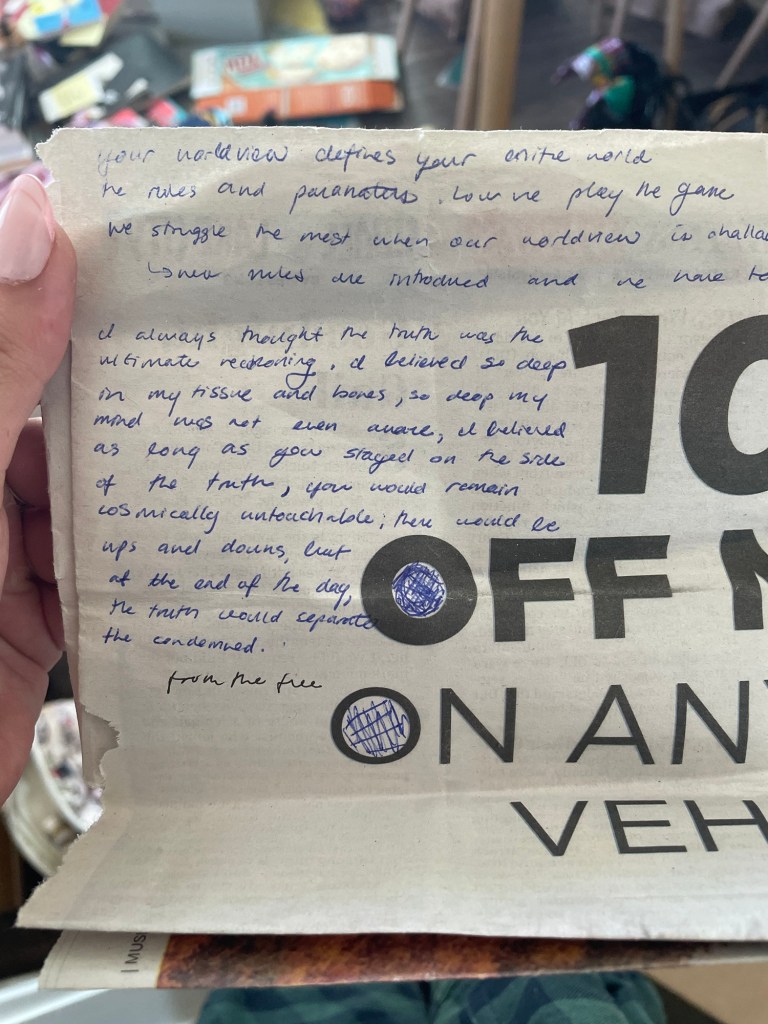
there are monsters in small places 1

“Come look at this, Hazel. It’s a sea monster,” Raymundo taunts. Hazel sticks out her chin.

“I know that’s not a sea monster. That’s a mamenomy,” she stumbles over the word. It waves its fingers at her, and in return she pokes its stomach to make it flinch away from her.

“Gotcha!” she grins. Ray grumbles and looks for something else to torment his sister with.

“Your cousins are pretty cute,“ Ezrah comments. Rosmond nods slowly and silently, but she does not speak. Ezrah surveys the boardwalk for an interesting conversation topic, but the small town of Brightview is a sleepy little thing, and he quickly grows restless.

“Why don’t we go play with them?” he asks, knowing Rosmond will not ignore a direct question.

“I shouldn’t get involved,” she says. Hazel and Ray move down the beach and Rosmond gets up to follow. Ezrah notices that she does not mention him in her response. She does not say that Ezrah should not leave her to play with her cousins, but he knows better than to leave her alone on the beach.

pentacle 1

PART 1 – THREE OF SWORDS

Adrian leaned casually on the funeral parlor’s overly decorative side table. Their backwards baseball cap sat at a slight angle and they were dressed perfectly casually, more appropriate for a baseball game than to make arrangements for their dead uncle’s funeral. But Adrian was alone. There was no one, no one there to tell them that they should dress nicer or show more respect, so Adrian was going to dress however they damn well pleased.

The undertaker motioned to Adrian with a stoic gesture of her head. Adrian sighed and followed her. Despite their casual attitude, they were dreading this moment. This unfortunate moment of finality.

Uncle Bahir had his own room. Which Adrian was sure he disliked greatly. He always craved attention and activity, and he was quick to laugh, a laugh that originated deep from his stomach.

Adrian quickly repositioned their baseball cap as a way to avoid their growing sentimentality. The undertaker lead them to the casket. Bahir was half uncovered by the two-part lid, as if tucked in for bed or something inane like that. He was done up, so to speak. The undertaker had worked her magic and Bahir looked better in death than he ever did in life. Though vivacious, he was prone to dark circles. Though he loved life, he also worked himself to the bone.

Adrian wondered if Bahir should have been shrouded in white, but they wouldn’t know what to say. They had been on a long-haul red-eye flight when funeral arrangements were put in to action. The shroud, even, was only something Adrian noticed in passing at the funeral of Uncle Bahir’s great aunt or third cousin or something like. Adrian only enjoyed in passing a connection with the muslim faith theoretically belonged to them.

The undertaker looked expectantly at Adrian. Adrian looked back at her.

“Yeah, he’s dead alright,” they said. The undertaker, a very professional undertaker, simply nodded and lead Adrian to her office to discuss the funeral details.

Was there ever, she reflected, a proper response to being shown the body of a loved one?

xavier 1

Xavier watched the new girl carefully. She was hiding something. That’s all he knew, but everybody who walked nervously though his door was hiding something, and his employer had made it clear that she had a secret, a secret that mysterious man wanted his hands on.

Xavier questioned this man’s motives, but who was he to refuse cold, hard cash? Not credits, real money. Real money that could buy real food and real clothes. Money that even a human couldn’t refuse. And all for one secret off this girl, this small, nervous girl who looked no older than sixteen.

The man had assured him that she was a 30, nothing he couldn’t handle, but she was hiding something, something that meant real money to a hooded figure with a raspy voice. Xavier smiled at the girl and stuck out his hand.

“Welcome, I’m Xavier.” The girl bit her lip and shook the offered hand.

“Elia.” He glanced at her report. Eris Athena, it said. This was the one. Her file was small and insignificant as she looked. An uneventful Sigma training and the early dismissal that so many unremarkable wizards received. He couldn’t say he was jealous.

Elia knew he wouldn’t be, but she didn’t care what he thought. Right now, she was
occupied with another thought: How would she hide who she really was? It was easy around humans. For all they knew, if you scored a 30 on the WAP, you were a 30, and that was that, but this kid was a wizard, a seer at that. Only Pi’s became seers. He would be powerful and would have no problem dealing with her tricks.

philoshper’s agenda 1

Volume I: A Study in Dæmons
Prologue: Not a Story for Children
The bartender noticed the girl as soon as she walked in. She was sitting as far away from other people as she could get with a dense history book spread out in front of her. The bartender knew he could get to her whenever he wanted and she would act as though it had taken only minutes, but he didn’t want to keep her waiting; a bartender could be quite
loyal to his regulars. He walked up to her in seconds.

“What’ll it be?” She looked out the small window at the slick streets.
“Awfully cold out today.”
“A mulled wine it is then.”
“Thanks, Alfie.”

When Alfie came back with her drink, the girl had again lost herself in the book. She reached absentmindedly towards the cup. Alfie leaned over the bar, slightly, in interest. Still unable to read a word, he drummed his fingers on the bar.

“What is it today?” She was studying Chemistry and Medieval and Renaissance History at university, and Alfie was always interested in learning more on any subject from a developing expert, someone so excited about something he found dry, and this girl always had a story to tell.

“I’m afraid it’s not a story to put one in a good mood,” she confessed. “It’s not a story for children; however, it is unfortunately about children.” She looked around at the other customers before she continued. It was one of the usual set of signals. Do you have time?

He nodded and leaned in. Go ahead.

“Have you heard of a man call Gilles de Raise?”
“I can’t say that I have.”
“You know his legacy I’m sure. He’s the very real basis for the legend of Bluebeard.”

Despite her warnings of a bad mood, Alfie was intrigued. The girl saw this and continued.
“The beginning of his life hardly gives hint to its end. He fought alongside Joan of Arc in the Hundred Years War and married into money, well, after squandering much of his
father’s, but the technicalities don’t change much. The man was desperate for money. He advertised for an alchemist, or anyone who dabbled in the occult. You would have to be a
fool to agree, but I suppose Prelati didn’t know that when he signed on. He knew what he was doing but not how far it would go.

“Gilles de Rais wanted to raise a demon. He drew up a contract while Prelati
attempted contact. The demon was to give de Rais wealth, in turn for what we’ll never know. In any case, the story ends the same. Prelati’s first three attempts were to no avail,
and de Raise grew impatient. In what was, perhaps, a desperate attempt to defend himself, the failing demon summoner told his master that this demon, the demon Barron it was
called, required an offering, an offering of the sort one should never provide. This offering…well, it represents a crime viler than almost any other, a crime against society. It should be selected against, evolutionarily; it just doesn’t make sense–”


“What was it?” Alfie interrupted. The girl pressed her lips together and looked up at him.

“This is the part that might put you in a bad mood.” Alfie shrugged.

“Haven’t got much else to do.” The girl looked away, staring to the left of his hands.

“He asked for…parts…of a child.” Alfie was undeterred.
“What parts?”
“Well, based on his method of killing,” she looked down a the book, tracing a few highlighted words, “could be head, limbs, organs, but…most likely genitals.”

Alfie nodded stiffly.
“Lovely.” The girl laughed and her gaze turned softer, more contemplative.

“Well, he brought the parts, whatever they were. And while most agree he
summoned no demon, I am sure he did, for a demon would live inside him and would destroy lives and families. It would give him no wealth, but maybe he received another reward, a reward to him but in the eyes of all others, a curse. Maybe pleasure from others’ pain is a reward for the beholder. Maybe for him–” Alfie interrupted another one of her tirades.
“What did he do?” She looked straight at him with an intensity that made him shiver
in the warm pub.
“He was a child-killer.”

Since he had already expressed his interest, Alfie was unable to escape a detailed account of the real Bluebeard’s preferred killing method and rituals. He was only able to escape after hearing the disposal method of cutting off and burning small pieces of the corpse one at a time when another customer hailed him from further down the bar. Alfie eagerly took the chance to bid her adieu, and Rosemary Clearwater returned quietly to her uplifting bit of
literature.

Chapter 1: An Objective Account of the Occult

I guarantee you will not believe a single word of what I am about to write. So unbelievable is it, even to myself, that I have enlisted the help of a few of my good friends, experts in these sorts of dealings, to write much of what will follow. However, I thought I myself
should take the time to enclose a brief note to assure you the accounts that follow are completely objective and entirely factual, and if you cannot believe that, I invite you to hear
what Rosemary Clearwater has to say on the matter.

Allow me a brief introduction. I am Rosemary Clearwater. I attend University College London, and, by special arrangement, my field of study is so completely nebulous that naming it as any subject in the realm of history or the natural science would not be entirely
the truth but would also involve no deception whatsoever. Anymore of my biography would be superfluous.
In an attempt to offer you the most detailed and accurate account possible, I shall take it upon myself to describe preliminary knowledge of this particular case:

The Occult is an umbrella term for practices and beliefs that often stem from mythology. It describes not just supernatural or mystical phenomenon but the attempt to create and control such events. It represents the simple leap from trying to explain the unexplainable to an expectable and natural grab for power. The Occult is no occupation, though it fully occupies all involved. Possession, by spirits, devil,
dæmons, etc., only occurs when one attempts to posses something that is not one’s own. Dæmons specifically are a wildly fascinating division of the Occult. They appear so frequently on the underbelly of popular literature and cinema and fears so readily in these media, yet they are quickly and glibly dismissed in broad daylight. The fascination with and belief in dæmons is not limited to horror films or fringe groups and hidden cults. Carl Jung himself identified the shadow, or the ‘evil’ contained in the Self, as its own dæmon to be faced and dealt with, suggesting that humankind as a whole is incurably possessed. In fact, the more contemporary psychoanalyst James Hillman…

Etc. etc. etc.

Snowflakes (Triptych)

Snowflakes
There were snowflakes on the tip of her nose. They kept melting into cold wet drops and sliding off, so she tipped up her chin to catch more.

The whole time, Robbie was watching her. She could feel, and tried to ignore the silence he directed her way. He was worried about her, or scared, or angry, she could tell. But she didn’t care. She
didn’t want to care.

“Don’t you want to—?“
“No,” she cut him off.”
“To talk about it. I was going to ask if you wanted to talk about it.” She didn’t respond.
“Someone died,” he continued’ “You’re allowed to feel anything.” The silence he ended with stretched around her, frozen into snow.
“I know,” she said quietly. “I know. But I don’t want to.” She looked down and the snowflakes slid off her nose.


The Mortician
Everyone told the mortician she mustn’t feel anything. But the mortician didn’t think that was fair, nor did she think it was necessarily true.

The mortician looked down at her work. Laid quite ceremoniously on her table was an old woman with hair curled perfectly into her chin. She looked motherly, grandmotherly, maybe. She was the old woman who hadn’t wanted a memorial, or a funeral, or a viewing. She didn’t want to make a fuss.

She never liked to be a bother to her family. And they might not ever see her again.

The mortician fussed with the old woman’s hair. Perfect as it already was. Her finger brushed the woman’s cheek.

Robbie
Robbie wondered if he would cry. The inside of the auditorium was sweaty and drunk and filled with whiskey breath settling on cheap karaoke microphones.

The stale air was a sharp contrast with the outside where snow lined the gentle hill leading away from the door and snowmen waited to die. Robbie had
always cried when he wanted to least, when he was angry, when he felt rejected, when he imagined long-
time friends rolling their eyes over his back because he was too old to be crying like this. And he pressed his head in his hands to keep the tears from sliding down his cheeks because he was too old to be crying like this.

And he never cried when he wanted to, never cried when it was okay to. When everyone would understand, his chest was as still and cold as a rock.

The fermenting air of the auditorium climbing around him, Robbie decided that he could no longer breathe. He decided he wanted to see the snowmen one more time, before they finally died.
She was still in the snow with nothing more than a sweatshirt.

“I want to talk about it,” Robbie croaked when he found her again. “We won’t even get to see her again.”
“Just watch the snow,” she whispered. “Try to catch it on your nose.”

duncan hall 1

11-26-21

Duncan Hall was someone who only orbited my life briefly, but still found a way to make his incision.

He continually would drift away then find some new, benign-seeming way to insert himself back into my life, a response to one of my querries on the email-forums of my small college. Then asking about me, my break. Querries unrealted to him. That he had no business replying to. In a 1-2 rythm, once before each break he returned, bridging my singular brush with him as more than just a passer-by. Maybe it’s self-centered to perceive it that way, but that’s how well all percieve life: with ourselves at the center of it all. Ourselves our central node of action and reaction, the only real point of feedback we have.

I was left percieving him through second-hand messages. Left constructing what his actions might mean from the smaller sum of his words.

Becasue he had a way of saying things without really saying anything at all. We could talk for hours about the number of selves contained in the mind, the meaning contained in the space between the end of one breath and the start of the next, and all the while, he could never allow himself to be contained by another person with any more committment than the start and end of a conversation.

As I left his suite lounge that night, I knew he had left too many signals unanswered, that my hope of him as more-than-a-friend or even as more than a mere spectre on the lanscape on my life would also, likely, be unanswered. But I allowed myself to be bouyed along by hope that had already seeded, nurtured by other words and actions, before the pulling-back, before I got close enough to see the fissures beneath the surface, the ones of the sort we all keep behind our smiles for strangers.

I, also, had the chance to percieve him through second-hand stories.

A friend of a friend was his girlfriend, on-and-off, bridging, reaching to either side of whatever was – or wasn’t – with me.

One night, a singular day before Valentine’s day, a symbolic holiday with no appartent purpose but to catalyze romantic reactions – towards their beginnings or ends, Duncan Hall stopped me in the stairwell to address my open-book eyes, my open-book attitude, my open-book crush on him. He told me that everything was breaking apart and that he had no idea when it would come back together. I think, now, I could diagnois his particular disease as the age of 23. In the moment, though, I thanked him for his honesty.

Three weeks later he was with her again.

She, too, loved his philisophical bent. Who knew, what an aphrodasiac topics of existentialism or the nature of self could be. Maybe if the secret got out, more guys would be philosophy majors.

But hearing her story makes me wonder what it actually means to be with someone. Where do we draw this imaginary line? With a kiss? With sex? When we have seen certain amounts of each others’ naked flesh?

Yes, she was with him physically but his resistence to closeness of other kinds, of being contianed by another person, remained.

They got high together one night. That’s when he told her. Told her he couldn’t be contained anymore. He probably had good reasons, good excuses, good coverups from the rational mind. But then again, we always do when we’re running away from fear.

She texted her friend, my friend one line.

This was a mistake.

code 400

The DSM defines Generalized Anxiety Disorder (GAD) as:

1. The presence of excessive anxiety and worry about a variety of topics, events, or activities. Worry occurs more often than not for at least 6 months and is clearly excessive.

I’m good at worrying about things, paranoia, anxiety etc. My mom taught me that. Don’t forget. Wear a raincoat. Check your work. Don’t go out alone.
I went to lunch alone sometimes, in high school. She didn’t like that. But it was a short walk to the deli. There was a guy there who knew my name, my favorite sandwich, who gave me free cookies, who wanted to go to a concert with me “sometime,” who tripped over things in his rush to talk to me.

I woke up that morning. And I couldn’t stop thinking about death. This happens sometimes when a thought appears and won’t melt away. Gets caught in the cogs.

Paul Atreides: I know, Thufir, I’m sitting with my back to the door. I hear you, Dr. Yueh, and Gurney coming down the hall.
Thufir Hawat: Those sounds could be imitated!

I never keep my back to doors, always know who’s behind me, if someone’s behind me, I always walk with a weapon: a keychain that’s louder than a car alarm when the chain is pulled, police approved, emergency LED, makes a great gift. My metal water bottle held like a baseball bat by my side. Ready. On edge. Armed.

A. A persistent fear of one or more social or performance situations in which the person is exposed to unfamiliar people or to possible scrutiny by others. The individual fears that he or she will act in a way (or show anxiety symptoms) that will be embarrassing and humiliating.

It had snowed all night. Cars slid off driveways, and we drove on the highway at 10 miles an hour. We get to school when English starts instead of 7:30 when choir starts. The halls are empty. It’s never been this peaceful, I think. Yesterday’s snow has melted and frozen into ice.

However, less well-known is the fight-flight-freeze response, which adds a crucial dimension to how you’re likely to react when the situation confronting you overwhelms your coping capacities and leaves you paralyzed in fear.

I freeze up a lot. When I can’t remember a word, when I can’t remember my argument, with the boy I told to come to the tennis match and I spent an hour leaning against the fence with, talking with. But I’m afraid to look at him, later. And I don’t know why.

I hate getting phone calls.

2. The worry is experienced as very challenging to control. The worry in both adults and children may easily shift from one topic to another.

A. They sit down on the couch next to you.
“Oh also, I can’t make it to your birthday.”
“Oh, really?”
“Yeah, I have a hockey game in Manchester. I was pissed.”

Sometimes no one responds to my texts. They always do it at the same time. Conspiracy, my brain cries. They all hate you. Some things get caught in the cogs.

So does this mean you’re not gonna come?

B. We are leaving the dance. Two young girls in floral dresses in an empty subway station. A man leans over the turnstiles. We have to pass him. Vulnerable in floral. We have to fumble for our Charlie Cards. In front of him.
“Hurry up,” he says. “What are you fuckin’ scared of it?”
He is behind me. Close. The turn style is not what I’m scared of.

The adrenal medulla secretes the hormone adrenaline. This hormone gets the body ready for a fight or flight response. Physiological reaction includes increased heart rate.

Fuck off,” I say. “You probably shouldn’t have done that,” people will say, later.

The fight or flight response can be seen in all mammals in response to threats.

3. The anxiety and worry are accompanied with at least three of the following physical or cognitive symptoms (In children, only one symptom is necessary for a diagnosis of GAD):

A. Difficulty sleeping (due to trouble falling asleep or staying asleep, restlessness at night, or unsatisfying sleep)

In 8th grade, I cheated on a worksheet. Got all the answers from my friend. When the teacher asked me about it, I told him. I didn’t even think about lying. Still. The guilt ate me up.

Eat up, verb, To overwhelm and/or easily defeat one due to being more aggressive, powerful, etc. A noun or pronoun can be used between “eat” and “up.”

At night. That’s usually when I think about death. It’s a grinding, squeaking, circular thought. It always comes back. Big wheel keep on turning. Proud Mary keep on burning.
The wheel in the sky keeps on turning.

It is the nightly custom of every good mother after her children are asleep to rummage in their minds and put things straight for next morning, repacking into their proper places the many articles that have wandered during the day. When you wake in the morning, the naughtiness and evil passions with which you went to bed have been folded up small and placed at the bottom of your mind and on the top, beautifully aired, are spread out the prettier thoughts, ready for you to put on.

Each morning I had a few moments of peace before the guilt, my failure would stab me in the stomach. I finally told my parents. It wasn’t my job to worry about it alone. They said.

B. Exposure to the feared situation almost invariably provokes anxiety, which may take the form of a situationally bound or situationally predisposed Panic Attack.

When I was 11, I was afraid of zombies. Terrified. Scared that Michael Jackson backup dancers would climb up to my second-floor bedroom and slam their poorly preserved fists on the double-paned window.

During the three weeks of Utah autumn, we used to collect leaves in big plastics bags and preserve them. Pressing them between sheets of plastic and letting mom seal them together with an iron.

We’re playing pool at 11 in a seedy pub in Inverness. The man at the next table is too sloshed to focus on his own game. That shot is shite. He says. But I won’t help her out. We know what that would look like. He’s funny, means no harm. But all I see is the man in the subway. What are you fucking scared of it? Experiencing over and over the moment paranoia became reality. The crossing over where don’t worry mom it’ll be fine loses its meaning.

Every year on Halloween they would show thriller again. I hid outside. Hid in the bathroom. Because each time it started, I knew the fear had been perfectly preserved, and I had no choice but to hide.

A mixture of these chemicals is known as embalming fluid and is used to preserve bodies of deceased persons for both funeral purposes and in medical research in anatomical laboratories.

C. The avoidance, anxious anticipation, or distress in the feared social or performance situation(s) interferes significantly with the person’s normal routine, occupational (academic) functioning, or social activities or relationships, or there is marked distress about having the phobia.

In 8th grade, there was a windstorm. The power was out all night. Half the shingles blew off our roof. Half the trees were knocked down or snapped in half. And in the Bible, there’s an untranslated word. I don’t remember what it was, but I said it again and again as I moved around the halls. As some reassurance. Hoping the house wouldn’t cave in because the floor was moving back and forth in the wind.

religion /rɪˈlɪdʒ(ə)n/ noun
1.
the belief in and worship of a superhuman controlling power, especially a personal God or gods.

We hung out behind the stairs in middle school. In 7th grade, Asher was shit talking the new testament, trying to impress his Jewish crush. I started to cry as I was telling him off. I wonder where that conviction went.

The lamb was sacrificed
Now we no longer fear the grave

delusion /dɪˈluːʒ(ə)n/ noun
1.
an idiosyncratic belief or impression maintained despite being contradicted by reality or rational argument, typically as a symptom of mental disorder.

The trees overhead made a great sound of letting down their dry rain.

4. The person recognizes that this fear is unreasonable or excessive.
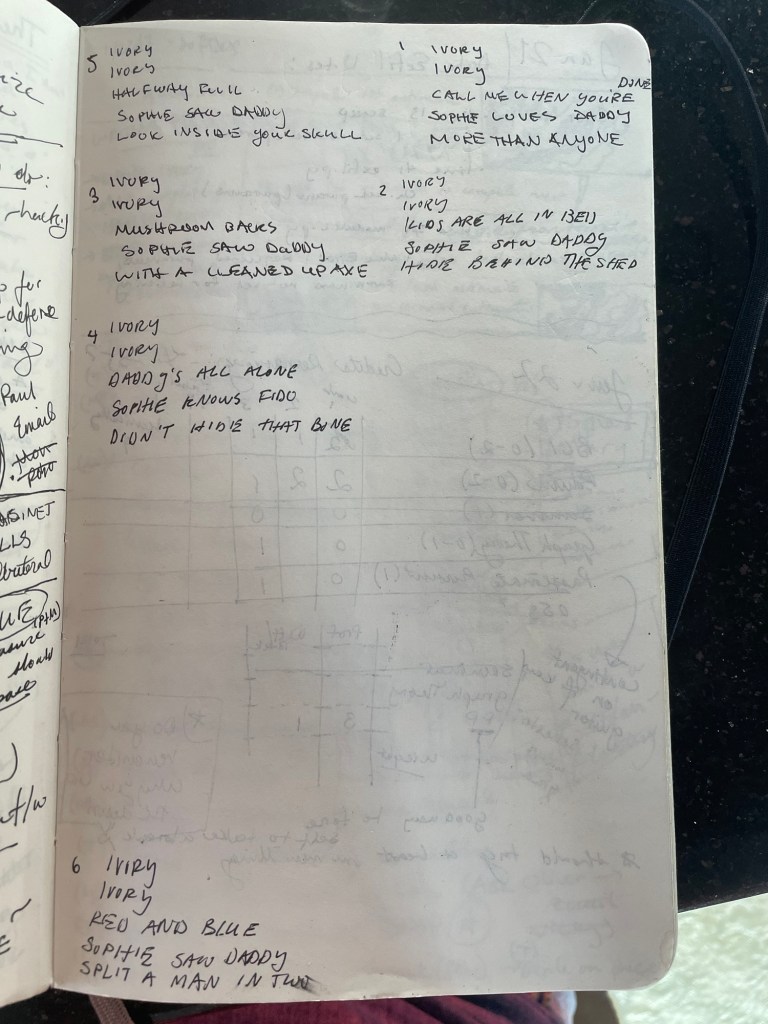
eyelidless

we rescued a baby squirrel today. nick thought there was something dead on the sidewalk back from Trim so we went back to look at it.

“that’s definitely not dead.” it was an ugly pink squirming thing, rolling back and forth as it stretched.

it had four names before it was even supposed to have one. Sophie said “…”

there were seven of us crowded into Sophie’s room around a reclaimed cardboard box.

the squirrel passed away between the hours of 5:30 and 8:30 in the morning.

she had a dream where she was pregnant, and all she could think was “this squirrel will live.”