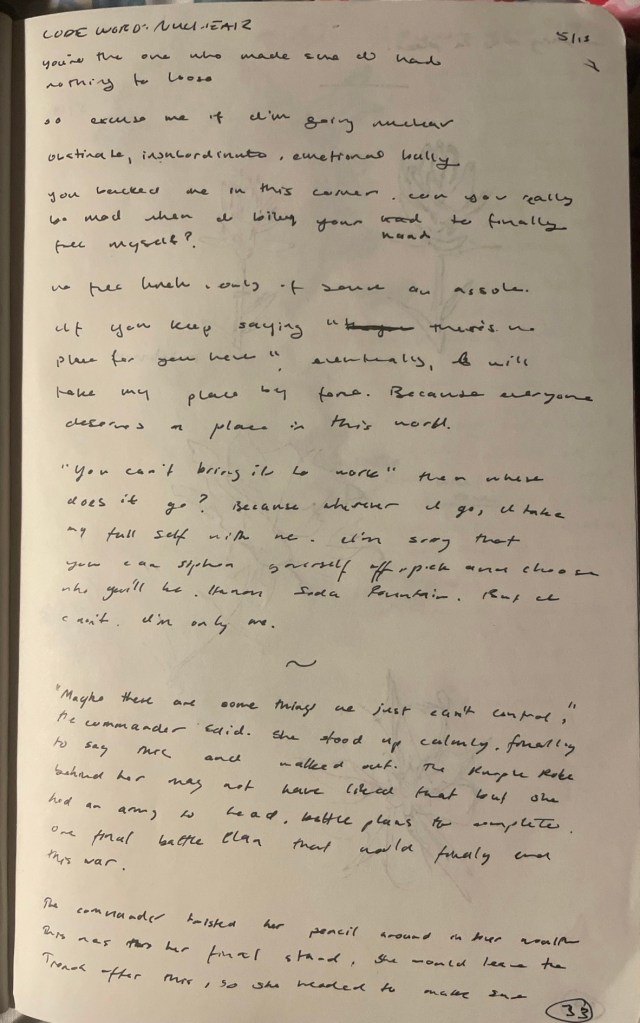
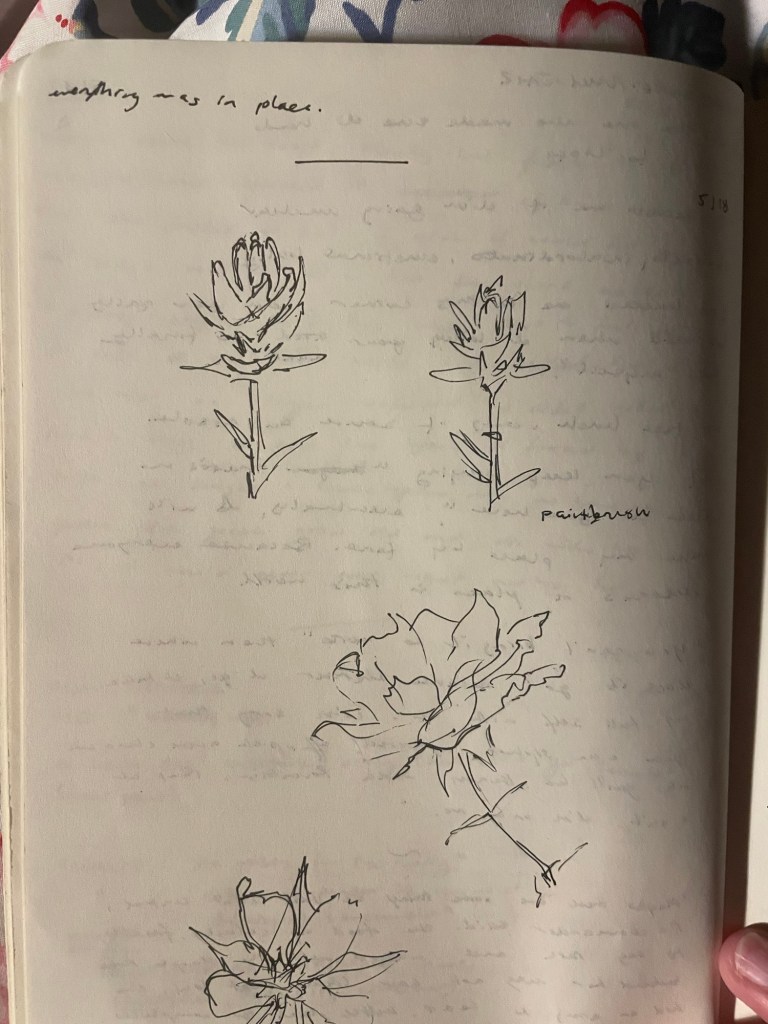
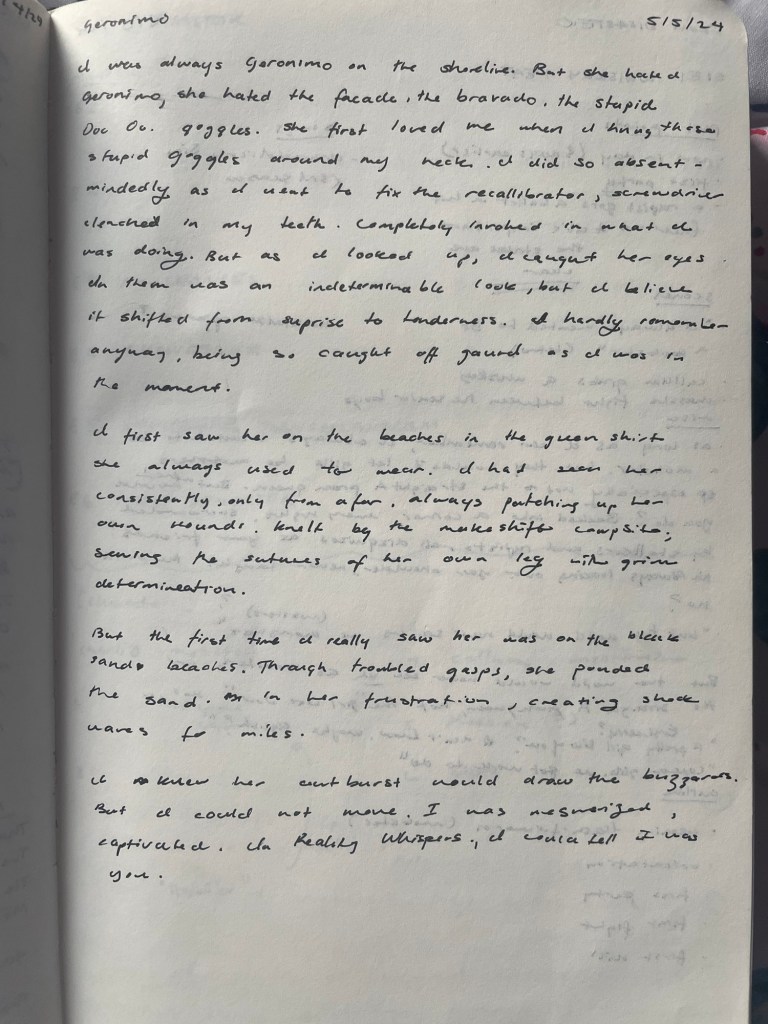
Snowflakes (Triptych)

Snowflakes
There were snowflakes on the tip of her nose. They kept melting into cold wet drops and sliding off, so she tipped up her chin to catch more.

The whole time, Robbie was watching her. She could feel, and tried to ignore the silence he directed her way. He was worried about her, or scared, or angry, she could tell. But she didn’t care. She
didn’t want to care.

“Don’t you want to—?“
“No,” she cut him off.”
“To talk about it. I was going to ask if you wanted to talk about it.” She didn’t respond.
“Someone died,” he continued’ “You’re allowed to feel anything.” The silence he ended with stretched around her, frozen into snow.
“I know,” she said quietly. “I know. But I don’t want to.” She looked down and the snowflakes slid off her nose.


The Mortician
Everyone told the mortician she mustn’t feel anything. But the mortician didn’t think that was fair, nor did she think it was necessarily true.

The mortician looked down at her work. Laid quite ceremoniously on her table was an old woman with hair curled perfectly into her chin. She looked motherly, grandmotherly, maybe. She was the old woman who hadn’t wanted a memorial, or a funeral, or a viewing. She didn’t want to make a fuss.

She never liked to be a bother to her family. And they might not ever see her again.

The mortician fussed with the old woman’s hair. Perfect as it already was. Her finger brushed the woman’s cheek.

Robbie
Robbie wondered if he would cry. The inside of the auditorium was sweaty and drunk and filled with whiskey breath settling on cheap karaoke microphones.

The stale air was a sharp contrast with the outside where snow lined the gentle hill leading away from the door and snowmen waited to die. Robbie had
always cried when he wanted to least, when he was angry, when he felt rejected, when he imagined long-
time friends rolling their eyes over his back because he was too old to be crying like this. And he pressed his head in his hands to keep the tears from sliding down his cheeks because he was too old to be crying like this.

And he never cried when he wanted to, never cried when it was okay to. When everyone would understand, his chest was as still and cold as a rock.

The fermenting air of the auditorium climbing around him, Robbie decided that he could no longer breathe. He decided he wanted to see the snowmen one more time, before they finally died.
She was still in the snow with nothing more than a sweatshirt.

“I want to talk about it,” Robbie croaked when he found her again. “We won’t even get to see her again.”
“Just watch the snow,” she whispered. “Try to catch it on your nose.”

duncan hall 1

11-26-21

Duncan Hall was someone who only orbited my life briefly, but still found a way to make his incision.

He continually would drift away then find some new, benign-seeming way to insert himself back into my life, a response to one of my querries on the email-forums of my small college. Then asking about me, my break. Querries unrealted to him. That he had no business replying to. In a 1-2 rythm, once before each break he returned, bridging my singular brush with him as more than just a passer-by. Maybe it’s self-centered to perceive it that way, but that’s how well all percieve life: with ourselves at the center of it all. Ourselves our central node of action and reaction, the only real point of feedback we have.

I was left percieving him through second-hand messages. Left constructing what his actions might mean from the smaller sum of his words.

Becasue he had a way of saying things without really saying anything at all. We could talk for hours about the number of selves contained in the mind, the meaning contained in the space between the end of one breath and the start of the next, and all the while, he could never allow himself to be contained by another person with any more committment than the start and end of a conversation.

As I left his suite lounge that night, I knew he had left too many signals unanswered, that my hope of him as more-than-a-friend or even as more than a mere spectre on the lanscape on my life would also, likely, be unanswered. But I allowed myself to be bouyed along by hope that had already seeded, nurtured by other words and actions, before the pulling-back, before I got close enough to see the fissures beneath the surface, the ones of the sort we all keep behind our smiles for strangers.

I, also, had the chance to percieve him through second-hand stories.

A friend of a friend was his girlfriend, on-and-off, bridging, reaching to either side of whatever was – or wasn’t – with me.

One night, a singular day before Valentine’s day, a symbolic holiday with no appartent purpose but to catalyze romantic reactions – towards their beginnings or ends, Duncan Hall stopped me in the stairwell to address my open-book eyes, my open-book attitude, my open-book crush on him. He told me that everything was breaking apart and that he had no idea when it would come back together. I think, now, I could diagnois his particular disease as the age of 23. In the moment, though, I thanked him for his honesty.

Three weeks later he was with her again.

She, too, loved his philisophical bent. Who knew, what an aphrodasiac topics of existentialism or the nature of self could be. Maybe if the secret got out, more guys would be philosophy majors.

But hearing her story makes me wonder what it actually means to be with someone. Where do we draw this imaginary line? With a kiss? With sex? When we have seen certain amounts of each others’ naked flesh?

Yes, she was with him physically but his resistence to closeness of other kinds, of being contianed by another person, remained.

They got high together one night. That’s when he told her. Told her he couldn’t be contained anymore. He probably had good reasons, good excuses, good coverups from the rational mind. But then again, we always do when we’re running away from fear.

She texted her friend, my friend one line.

This was a mistake.

code 400

The DSM defines Generalized Anxiety Disorder (GAD) as:

1. The presence of excessive anxiety and worry about a variety of topics, events, or activities. Worry occurs more often than not for at least 6 months and is clearly excessive.

I’m good at worrying about things, paranoia, anxiety etc. My mom taught me that. Don’t forget. Wear a raincoat. Check your work. Don’t go out alone.
I went to lunch alone sometimes, in high school. She didn’t like that. But it was a short walk to the deli. There was a guy there who knew my name, my favorite sandwich, who gave me free cookies, who wanted to go to a concert with me “sometime,” who tripped over things in his rush to talk to me.

I woke up that morning. And I couldn’t stop thinking about death. This happens sometimes when a thought appears and won’t melt away. Gets caught in the cogs.

Paul Atreides: I know, Thufir, I’m sitting with my back to the door. I hear you, Dr. Yueh, and Gurney coming down the hall.
Thufir Hawat: Those sounds could be imitated!

I never keep my back to doors, always know who’s behind me, if someone’s behind me, I always walk with a weapon: a keychain that’s louder than a car alarm when the chain is pulled, police approved, emergency LED, makes a great gift. My metal water bottle held like a baseball bat by my side. Ready. On edge. Armed.

A. A persistent fear of one or more social or performance situations in which the person is exposed to unfamiliar people or to possible scrutiny by others. The individual fears that he or she will act in a way (or show anxiety symptoms) that will be embarrassing and humiliating.

It had snowed all night. Cars slid off driveways, and we drove on the highway at 10 miles an hour. We get to school when English starts instead of 7:30 when choir starts. The halls are empty. It’s never been this peaceful, I think. Yesterday’s snow has melted and frozen into ice.

However, less well-known is the fight-flight-freeze response, which adds a crucial dimension to how you’re likely to react when the situation confronting you overwhelms your coping capacities and leaves you paralyzed in fear.

I freeze up a lot. When I can’t remember a word, when I can’t remember my argument, with the boy I told to come to the tennis match and I spent an hour leaning against the fence with, talking with. But I’m afraid to look at him, later. And I don’t know why.

I hate getting phone calls.

2. The worry is experienced as very challenging to control. The worry in both adults and children may easily shift from one topic to another.

A. They sit down on the couch next to you.
“Oh also, I can’t make it to your birthday.”
“Oh, really?”
“Yeah, I have a hockey game in Manchester. I was pissed.”

Sometimes no one responds to my texts. They always do it at the same time. Conspiracy, my brain cries. They all hate you. Some things get caught in the cogs.

So does this mean you’re not gonna come?

B. We are leaving the dance. Two young girls in floral dresses in an empty subway station. A man leans over the turnstiles. We have to pass him. Vulnerable in floral. We have to fumble for our Charlie Cards. In front of him.
“Hurry up,” he says. “What are you fuckin’ scared of it?”
He is behind me. Close. The turn style is not what I’m scared of.

The adrenal medulla secretes the hormone adrenaline. This hormone gets the body ready for a fight or flight response. Physiological reaction includes increased heart rate.

Fuck off,” I say. “You probably shouldn’t have done that,” people will say, later.

The fight or flight response can be seen in all mammals in response to threats.

3. The anxiety and worry are accompanied with at least three of the following physical or cognitive symptoms (In children, only one symptom is necessary for a diagnosis of GAD):

A. Difficulty sleeping (due to trouble falling asleep or staying asleep, restlessness at night, or unsatisfying sleep)

In 8th grade, I cheated on a worksheet. Got all the answers from my friend. When the teacher asked me about it, I told him. I didn’t even think about lying. Still. The guilt ate me up.

Eat up, verb, To overwhelm and/or easily defeat one due to being more aggressive, powerful, etc. A noun or pronoun can be used between “eat” and “up.”

At night. That’s usually when I think about death. It’s a grinding, squeaking, circular thought. It always comes back. Big wheel keep on turning. Proud Mary keep on burning.
The wheel in the sky keeps on turning.

It is the nightly custom of every good mother after her children are asleep to rummage in their minds and put things straight for next morning, repacking into their proper places the many articles that have wandered during the day. When you wake in the morning, the naughtiness and evil passions with which you went to bed have been folded up small and placed at the bottom of your mind and on the top, beautifully aired, are spread out the prettier thoughts, ready for you to put on.

Each morning I had a few moments of peace before the guilt, my failure would stab me in the stomach. I finally told my parents. It wasn’t my job to worry about it alone. They said.

B. Exposure to the feared situation almost invariably provokes anxiety, which may take the form of a situationally bound or situationally predisposed Panic Attack.

When I was 11, I was afraid of zombies. Terrified. Scared that Michael Jackson backup dancers would climb up to my second-floor bedroom and slam their poorly preserved fists on the double-paned window.

During the three weeks of Utah autumn, we used to collect leaves in big plastics bags and preserve them. Pressing them between sheets of plastic and letting mom seal them together with an iron.

We’re playing pool at 11 in a seedy pub in Inverness. The man at the next table is too sloshed to focus on his own game. That shot is shite. He says. But I won’t help her out. We know what that would look like. He’s funny, means no harm. But all I see is the man in the subway. What are you fucking scared of it? Experiencing over and over the moment paranoia became reality. The crossing over where don’t worry mom it’ll be fine loses its meaning.

Every year on Halloween they would show thriller again. I hid outside. Hid in the bathroom. Because each time it started, I knew the fear had been perfectly preserved, and I had no choice but to hide.

A mixture of these chemicals is known as embalming fluid and is used to preserve bodies of deceased persons for both funeral purposes and in medical research in anatomical laboratories.

C. The avoidance, anxious anticipation, or distress in the feared social or performance situation(s) interferes significantly with the person’s normal routine, occupational (academic) functioning, or social activities or relationships, or there is marked distress about having the phobia.

In 8th grade, there was a windstorm. The power was out all night. Half the shingles blew off our roof. Half the trees were knocked down or snapped in half. And in the Bible, there’s an untranslated word. I don’t remember what it was, but I said it again and again as I moved around the halls. As some reassurance. Hoping the house wouldn’t cave in because the floor was moving back and forth in the wind.

religion /rɪˈlɪdʒ(ə)n/ noun
1.
the belief in and worship of a superhuman controlling power, especially a personal God or gods.

We hung out behind the stairs in middle school. In 7th grade, Asher was shit talking the new testament, trying to impress his Jewish crush. I started to cry as I was telling him off. I wonder where that conviction went.

The lamb was sacrificed
Now we no longer fear the grave

delusion /dɪˈluːʒ(ə)n/ noun
1.
an idiosyncratic belief or impression maintained despite being contradicted by reality or rational argument, typically as a symptom of mental disorder.

The trees overhead made a great sound of letting down their dry rain.

4. The person recognizes that this fear is unreasonable or excessive.

eyelidless

we rescued a baby squirrel today. nick thought there was something dead on the sidewalk back from Trim so we went back to look at it.

“that’s definitely not dead.” it was an ugly pink squirming thing, rolling back and forth as it stretched.

it had four names before it was even supposed to have one. Sophie said “…”

there were seven of us crowded into Sophie’s room around a reclaimed cardboard box.

the squirrel passed away between the hours of 5:30 and 8:30 in the morning.

she had a dream where she was pregnant, and all she could think was “this squirrel will live.”

siren’s shanty 2

She carefully shines the bottom of a tall thin Collins glass. She has the time. The bar is dead. The creak of the door breaks the silence. She looks up. Unhurried.

“Has Mr. Williams been by yet?” he asks, sitting down. She picks up another glass.

“Didn’t he die two weeks ago?”

“Two weeks,” he agrees. “I buried him a week ago and he still hasn’t found his way here?”

“Nope, no sign. But this fellow here,” she gestures to an empty stool, “just washed in. He fought in the Vietnam war.

“How’d he end up here?” he asks
She gestures to the rolling waves from the west-facing window.

siren’s shanty 1

Spirts dwell not only in the places they die, but more often in the places they lived, the places they loved. Some spirits, however, get lost trying to find their way from the first place to the second. Like the sailors lost at sea, or the fishermen who have fallen in, or even a spirit stranded many miles from home across a strange insurmountable ocean. These spirits spend weeks, years, centuries tumbled in the unfeeling waves, but eventually, they all wash up here, shake themselves off, and step in for a pint.

sun road 2

At our carefully planned rest stop, Emma and Eleanor, nearly inseparable themselves, giggled to themselves as they picked out and Emma bought what would seem even to the most sugar hungry to be too much candy. Eleanor’s parents were not rich, and that in an expensive private school as ours made her feel always slightly out of place. Her finances felt to her like a dark secret that she confided in Evony and Davynn late one night on a school trip to DC. She lived in a small house on Westminster Avenue, she had two sisters, and though she was as quiet as a mouse, she played the piano like a queen. Her quietness too she carried like a burden, and none but her closest friends would often hear her talk.

The rest of us easily paired off as well. The strange group we had gathered was made up of these pairs with tenuous connections between them. It seemed odd that this had happened. Senior trips took longer than two months to plan and were talked about since the beginning of the year, not since there were four extra spaces in a grey rental van. But Emma had wanted to take a trip, and she had wanted to take a big trip. She gathered and convinced her friends, but all others she recklessly asked had other plans. But Emma wanted a bigger trip, with more people and more to do, so Evony arranged to rent an eight-person van and asked me quietly to bring three of my own. Those I could convince stopped at two, so Ansel would extend the offer to his closest friend, Joseph, and that, it seemed, was the strangest part of the trip. No one had expected Joseph to agree. They expected him to have parties to go to and girls to hook up with. They expected him mostly to have better things to do than to be seen with them. The small Thursday group rang with shock when he accepted, but they moved over silently to accommodate him as he marked his own stop in the flashy city of Vegas.

Joseph would be the first I would choose for the sun god to take. He was almost universally disliked, to all appearances a jerk. I knew him from my synagogue and our families were friends. We were on good terms, but he had never been nice. The constant dislike directed at him by peers and teachers alike seemed not to silence him but to egg him on. He became worse when girls yelled at him for pulling their hair when he sat behind him. He interrupted more when he was told to shut up. But he was a good person. Evony, in her own silently steaming hatred of him, knew this as well. He found her once in the back of a bus, yelling at a gaggle of friends-not-her-friends, insisting that she would not be forced from the coveted three-seat row, ending with a plea, tears edging around her voice, “I just want someone to sit by me.” In what seemed to be, but was not, the valiant beginning of a love story, Joseph stepped up from nowhere and offered his unexpectedly valiant words, “I’ll sit next to you.” Evony would hold it against herself that she never made it up to him, but he would not be taken by the sun god.

We left the grimy gas station buzzing and groaning in anticipation. Not all of us were the mountain-going nature-loving sort, but we each got one stop, that was the deal, and none of us knew that Evony’s would take us to the sun god. There were grumbles as Askii and Ansel, the tallest of the group, folded themselves in the back of the van, and Evony, sated with a bag of jerky and an aggressively fizzing bottle of Diet Coke, took her place in the driver seat to bring us through the mountains she had chosen, to bring us into the land of the sun god.

sun road 1

The Blackfeet have a legend about a sun god, or a god that came from the sun, anyway. He came down from a towering flat-topped mountain and taught the first of their people to hunt and fish. He went back to the sun, but his face is still outlined below the summit of the mountain, pointy nose and long chin, filled in by snow slowly melting away in the sun.

If any of us should be taken away by the sun god, my first thought would be of Evony. In fact, it often seemed that she had already been taken away. Evony, a third-generation German whose skin deepened to bronze in the summer, seemed to always live half on earth and half above the clouds where a young Christian would look for heaven. She often wondered if the image she frequently revisited of a room made of clouds was one she had dreamed to help herself sleep or if she had read it in a book a few years ago about gods who walked among men. It was always dark in that room, which told you more about her than most people knew.

As I manned the steering wheel of the dark grey van on a straight-as-an-arrow freeway to the green mountains of our next stop and Evony stared up from her creased paperback, I wondered what in her head would keep her so ensnared from the world around her. She both read quietly and looked out the window absently, but each could only hold her attention in shifts and I had never seen someone read a book like that.

This road trip was carefully planned in shifts and rotations: Evony, navigating for me, would drive next with Davynn by her side. Davynn and Evony were best friends in a way that no one else could imagine being friends. Their friendship, surrounded in movie-like perfection, was characterized by similarity and self-sacrificing loyalty. They had once laughingly told me, years after the fact, that they had both been in love with me in junior high, but Davynn had never said anything because Evony admitted to it first. I tried to ignore the sting I felt when they told me because their telling me meant that the love they felt had passed.

Davynn herself seemed to have her feet planted firmly on the ground, but Evony, and Evony only, knew the the worlds her mind leaped into when she was alone, or felt alone grouped in a gathering of loud strangers. So if Evony had been asked to guess which of the eight travelers would be taken against their will to the sun god, she would consider Davynn, even though all others thought her to be unyieldingly logical. When Evony carefully introduced us carefully, two strangers who knew each other’s names, Davynn’s clipped words and internal silences lead me to think that she had seen something she did not like, but I was assured later by her friends and nervous approaches that she found in me a rare and unassuming friendliness. What Evony understood was that Davynn felt such depth of emotion that she could chose to siphon herself off from the world or to let it overwhelm her.

But neither Evony nor Davynn, the two inseparable friends, would be taken away by the restless sun god, and I would let the road pass to the next gas station without asking the brown-haired German-American what weighed down her mind.